
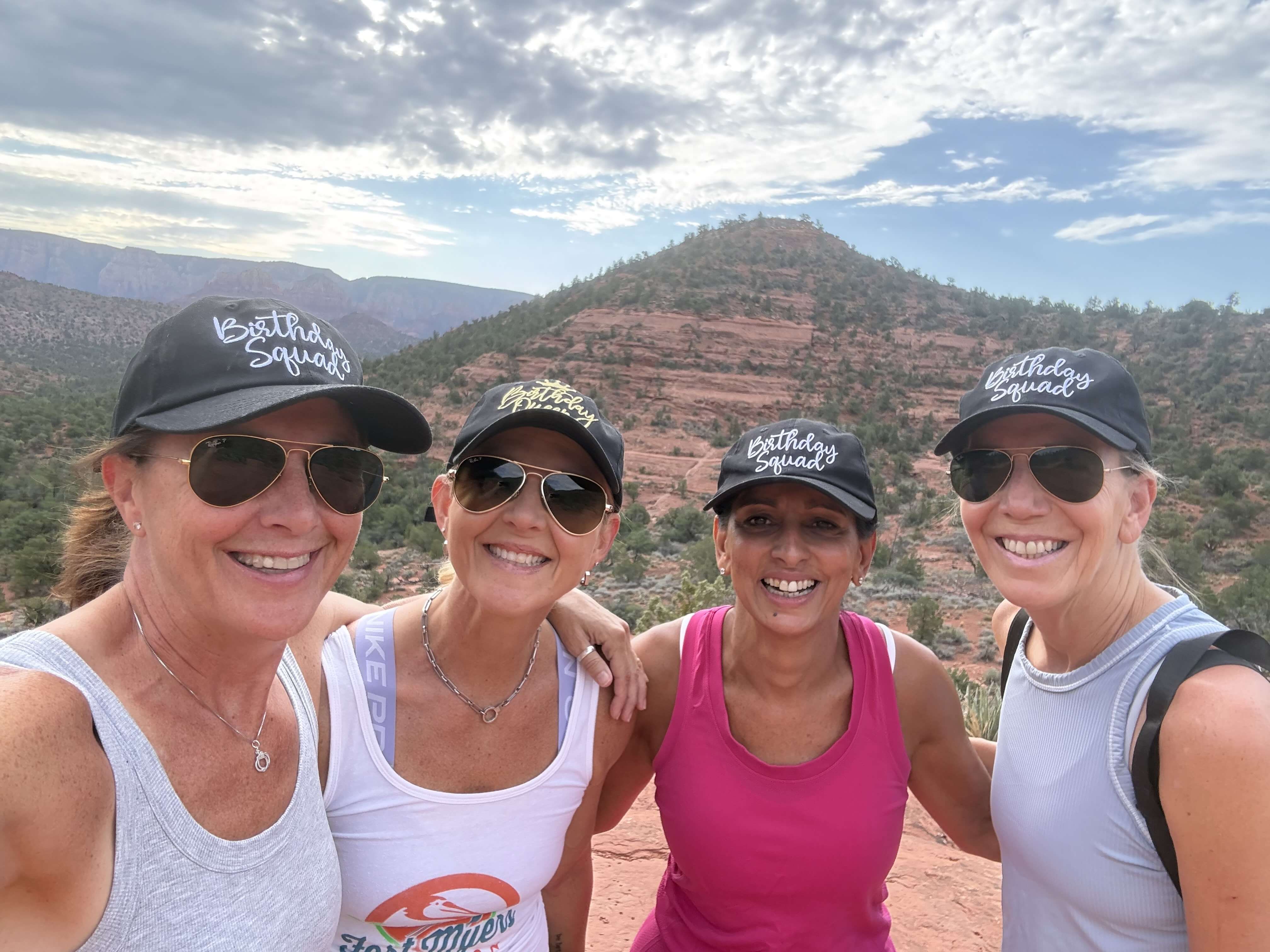
We hit the summit around eleven, four of us, sweaty and out of breath and grinning like idiots. It was my fifty-third birthday. My friends had planned for it: a baseball cap for the birthday girl, “birthday squad” hats for the rest of the crew. No tiara. That’s not me. I’m sporty, not sparkly, and they know it. The mountain hadn’t been in on the joke, though. It was a real climb, and we’d earned the top of it in matching hats anyway.
My friend looked out at the drop below us and said, “I’m never peaking.”
I laughed. Then I felt it land somewhere it wasn’t supposed to.
Because I have been peaking. Quietly. For a while. And I hadn’t called it that until she handed me the word.
Here’s what peaking looks like when you’re me. It doesn’t look like quitting. It looks like a full calendar.
A few years ago I noticed something I liked the feel of: I could fill a speaking schedule with what I already knew. I had two decades of fires, failures, and hard-won lessons sitting in my back pocket, and every one of them was good. Audiences responded. Planners rebooked me. I could stand on a stage and hand people something true without having to go find anything new first.
That’s not a small thing. I earned every one of those stories the hard way, and I don’t regret a single one of them. But somewhere in there, the job quietly changed. When I was still working, every day handed me new material whether I wanted it or not. A new crisis. A new mistake to own. A new lesson I hadn’t asked for and couldn’t skip. I wasn’t collecting stories on purpose. Life kept confiscating my ignorance and replacing it with something better.
Once I left that job, the confiscating stopped. And I didn’t notice, because the calendar still looked full. A full calendar isn’t the same thing as a full life. I knew that. I just didn’t think to apply it to myself.
A retired neurosurgeon named Dr. Brian Hoeflinger posted something recently that named the mechanism for me. He explained that the brain doesn’t track time the way a clock does. It tracks change. When your days stop varying, your brain stops laying down distinct memories, and months start compressing into each other until a year can pass and leave almost no trace. The fix, he said, is new experience. New routes. New rooms. New material for the brain to actually record.
I read that and thought about my speaking calendar, and I felt caught.
Because a highlight reel, however true, however hard-earned, is still a loop. Tell the same five stories long enough, and you’re not teaching anymore. You’re performing your own retirement.
Just months before that hike, I did something a person with a finished career and a pension already coming in doesn’t need to do. I went back to school. Not for a credential. My résumé doesn’t need another line. At the time, I couldn’t have told you exactly why. I just knew I wanted to be a beginner again, badly enough to feel it. It took a friend, months later, standing on a mountain, handing me one sentence, for me to understand the decision I’d already made.
I will tell you honestly, it is not going well in the way I expected. I’m behind on reading. I’ve rewritten the same section of a research paper more times than I can count. I sit with material some nights and understand about sixty percent of it, which is a humbling number for someone who used to walk into a room and be the expert. There is no stage, no applause, no rebooking. Just the slow, unglamorous work of not knowing something yet.
And that not-knowing is the whole point. It’s the thing that was missing. It’s what makes the days distinct again instead of interchangeable. I don’t know yet what I’ll do with half of what I’m learning. I just know that every hard class, every rewritten section, every moment of feeling behind, is going into the same account those twenty years on the job used to fill. And someday, on some stage, I’ll hand it to someone who needs it. That’s not wasted struggle. That’s the next round of material, being earned the same way the first round was: by not being comfortable.
And here’s the truer version of what happened on that ridge. I don’t actually want to speak from the summit. I know what it looks like up there. Hats, photos, everybody grinning, the view already won. It’s a fine place to stand for ten minutes. It’s a hollow place to talk to a room full of people who are still climbing. I do my best work, and my most honest work, from the middle. From the part where my footing is bad and my legs are shaking and some part of me wants to turn around and call it a day. That’s the only vantage point I actually trust myself to teach from. Not the top. The struggle underneath it.
Somewhere in your life, you have a full calendar that you’ve mistaken for a full life. Maybe it’s a job you could now do with your eyes closed. Maybe it’s a marriage running on old inside jokes instead of new ones. Maybe it’s a skill you mastered once and haven’t been bad at anything since, because you quietly stopped trying things you might be bad at.
None of that is failure. It might even look, from the outside, like arrival. That’s what makes it dangerous. Peaking doesn’t feel like decline while it’s happening. It feels like Groundhog Day. Same version of you, waking up to a slightly different date on the calendar. You do the thing you’re good at, and you call it a well-earned rest. Right up until you realize you’ve been living the same year on repeat and calling it a life.
The question isn’t whether you’ve earned the rest. You probably have. The question is whether you’ve quietly turned a rest stop into a permanent address.
So ask yourself what you stopped trying to be bad at. Ask what you’ve been coasting on that used to cost you something. Then go be a beginner at it again, on purpose, even though nobody’s requiring it of you.
This is your moment of reckoning. Step into it.
